

Six kilometres west of Birmingham city centre lies the small town of Smethwick, home to one of Central England’s most famous landmarks – Galton Bridge. Recognised as a Grade I listed structure (the highest level of heritage protection), the bridge attracts architecture enthusiasts from all over the world. Tourists visiting Birmingham often plan a trip to Galton Bridge to witness its grandeur and enjoy the surrounding natural beauty. Read more on birmingham-future.
History
Galton Bridge is regarded as a 19th-century engineering marvel. It was first opened to traffic in 1829 and was originally built as a road bridge to facilitate transport over the Birmingham Canal. The structure was designed by Thomas Telford, a Scottish civil engineer renowned worldwide for his work in tunnel, highway, and bridge construction. Telford designed six major bridges, but Galton Bridge is the only one that has survived to this day near Birmingham.
The bridge remained in use for vehicles until the 1970s, when new roads rendered it unnecessary for traffic. At that time, over 140 years old, Galton Bridge faced demolition. However, local residents of Central England protested, leading to not only its preservation but also a renovation to address structural defects. The bridge was converted into a pedestrian walkway, and today, it is primarily used by tourists admiring the architectural landmark. It is also accessible to cyclists and scooter riders.
Features of the Bridge
Galton Bridge is a robust cast-iron structure with a single-span arch measuring approximately 45 metres. The construction features decorative elements, some of which remain intact to this day, including ornate lampposts. The bridge is supported by six beams, and its height reaches 21 metres. Thomas Telford took great pride in this project.
At the time, cast iron was not a widely used construction material. Telford explained that the decision to build Galton Bridge from cast iron was based on safety and cost-efficiency considerations. Stone bridges over water were considered unreliable, with instances where flooding had proven stronger than masonry. Using cast iron instead of stone was an innovative and ultimately effective engineering solution.
The renovation work in the 1970s was minimal. The bridge was repainted and restored in areas where cracks and other defects had appeared. However, its original appearance was carefully preserved, allowing Galton Bridge to be recognised as a historic, architectural, and cultural landmark.
Other Notable Bridges in Birmingham
Galton Bridge is not the only bridge that tourists in Birmingham admire. The city and its surroundings are home to several notable bridges, all much younger than Galton Bridge but unique in their own way. In recent years, some of the most popular among visitors include:
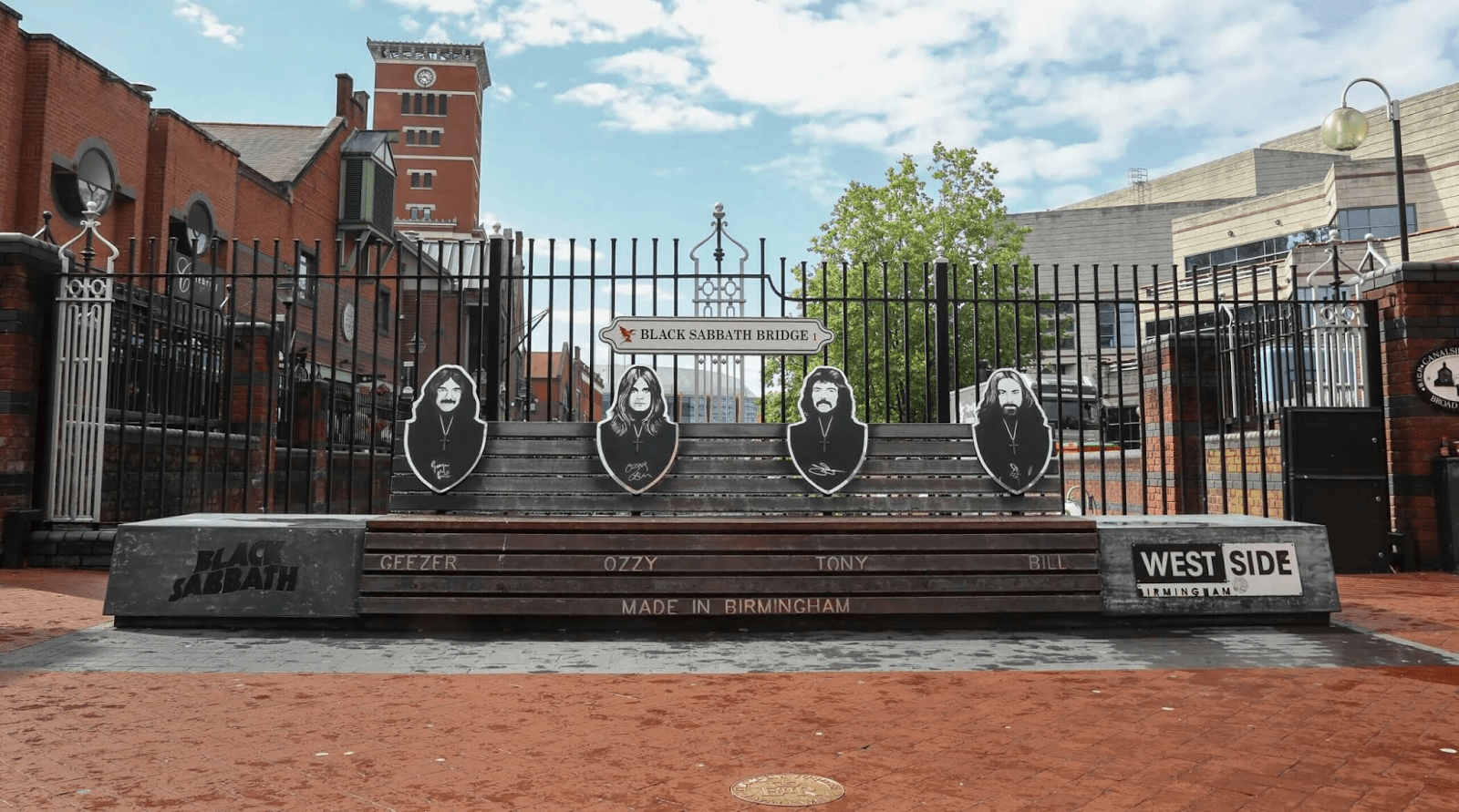
- Black Sabbath Bridge – Built to honour the legendary Birmingham metal band Black Sabbath, this bridge features a memorial bench dedicated to the four band members.
- Lovers’ Bridge – Like in many other major European cities, Birmingham has a bridge popular among couples. It has become a tradition to attach heart-shaped padlocks to its railings as a symbol of eternal love.
- Worcester Bar Footbridge – A pedestrian bridge that has become a favourite “photo spot” for visitors to Birmingham. It offers a stunning view of the canal system, beautiful urban architecture, and the luxurious “The Canalside” hotel.